Rubber Compounds: Composition and Why It Matters
The quality of a finished rubber product depends not only on the type of rubber but also on the correct formulation of the compound. From the same rubber base, using different recipes, it is possible to obtain products with completely different properties. In this article we explain the main components of a rubber compound and the role of each.
The main components of a rubber compound
A typical compound consists of several groups of substances:
- Rubber (polymer) base — forms the foundation of the compound (EPDM, NBR, SBR, etc.) and determines the basic elastic properties.
- Fillers — provide strength, hardness and volume.
- Vulcanization system — cross-links the polymer chains.
- Plasticizers — facilitate processing and adjust elasticity.
- Additives — antioxidants, colorants, flame retardants.
Fillers: the source of strength
The most widely used reinforcing filler is carbon black. It significantly increases tensile strength, abrasion resistance and hardness — which is why most technical rubber products are black. In light-colored products, mineral fillers such as silica (silicon dioxide) or calcium carbonate are used. The type and amount of filler directly affect the Shore hardness.
Vulcanizing agents
Vulcanization is a chemical process that turns rubber from a sticky, plastic mass into a strong, elastic material. The most traditional agent is sulfur, but in EPDM and peroxide-cured systems, peroxide agents are used. Accelerators and activators (zinc oxide, stearic acid) optimize the process. We explained this topic in more detail in the what is vulcanization article.
Why the recipe is so important
A correctly formulated compound determines the entire service life of the product. The wrong recipe leads to the following problems:
- Premature cracking and aging;
- Swelling under the influence of oil or chemicals;
- Permanent deformation under compression (compression set);
- Loss of elasticity with temperature changes.
This is why serious manufacturers develop and test the compound for each application in the laboratory. At NUR KAUÇUK, this process is managed by a quality control system, and every batch is inspected.
Adaptation to the application
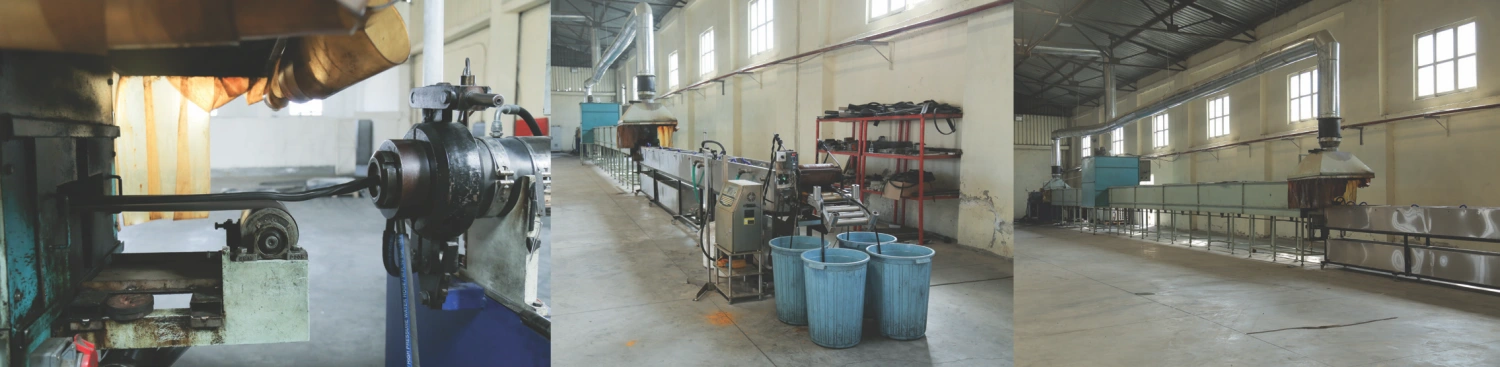
According to the customer's requirements, the compound can be customized as oil-resistant, flame-resistant, food-contact compliant or UV-resistant. This flexibility is precisely the advantage of compound technology. You can find more information about our production process on the production page.
If you need a special rubber compound for your project, see our product range or contact us to discuss your technical requirements.